

 English
 中文简体
中文简体 русский
CNC Sawing Machine Selection for High Precision Industrial Applications
In precision-driven manufacturing environments, equipment selection plays an important role in determining overall production stability and output consistency. Within metal cutting systems, Steel Bar Saw and CNC Sawing Machine technologies are often evaluated together because they support different levels of cutting requirements within the same production chain. Selection decisions are usually influenced by accuracy demands, production volume, and system integration needs rather than basic cutting capability alone.
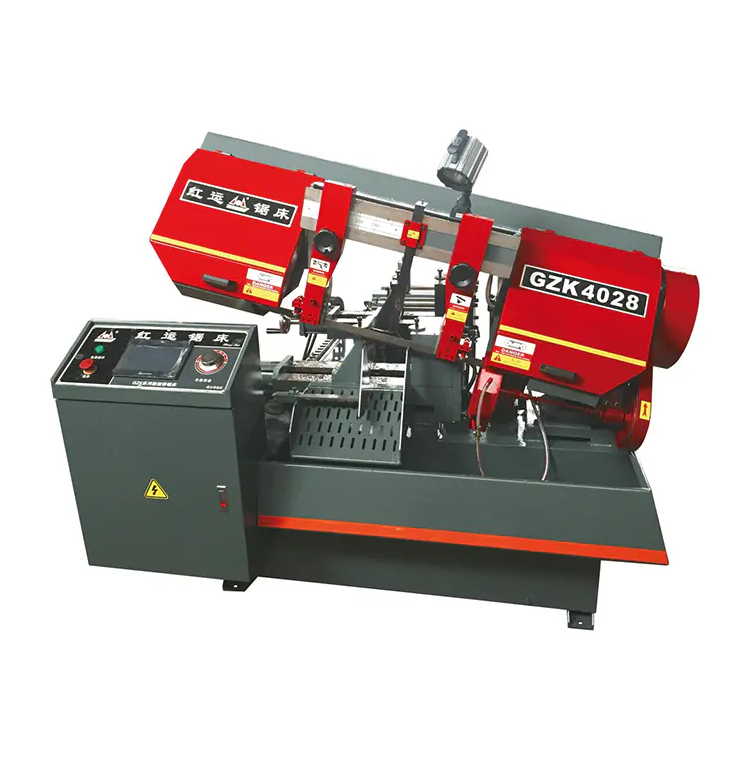
A CNC Sawing Machine is typically used when cutting operations require programmable control, repeatable accuracy, and structured processing sequences. A Steel Bar Saw is more commonly applied in general cutting tasks where flexibility and material throughput are prioritized. In high-precision applications, both systems may still appear together, but the CNC-based system becomes the central focus during selection planning.
Precision Requirements in Industrial Cutting
Precision is one of the key factors influencing CNC Sawing Machine selection. Many industrial applications require consistent length accuracy across multiple cutting cycles. A CNC system supports controlled feed rates and programmable cutting paths, helping maintain uniform output.
While a Steel Bar Saw can handle general cutting tasks effectively, its precision level depends more on mechanical setup and operator control. In comparison, a CNC Sawing Machine reduces variation by relying on automated execution, making it suitable for applications where dimensional consistency is required across large batches.
Material Compatibility and Cutting Range
Different industrial environments process a wide range of materials, including carbon steel, stainless steel, and alloy-based metals. During selection, material type directly influences machine configuration choices.
A Steel Bar Saw is often chosen for general-purpose material processing, especially where flexibility is needed. A CNC Sawing Machine, however, is selected when different materials must be processed under controlled cutting parameters. Feed speed, blade type, and cooling systems are adjusted based on material hardness and thermal behavior.
Automation Level and Control Systems
The level of automation is a major consideration in CNC Sawing Machine selection. Modern systems often include programmable controllers that allow operators to define cutting lengths, sequences, and batch processing logic.
A Steel Bar Saw may operate with simpler control structures, focusing on repeatable manual or semi-automatic cutting cycles. In contrast, CNC systems are designed to reduce manual intervention and improve consistency across multiple production runs. Integration with broader production systems also becomes easier when control logic is standardized.
Production Volume and Workflow Requirements
Selection is also influenced by expected production volume. High-volume environments often benefit from CNC Sawing Machine systems due to their ability to maintain consistent cutting cycles over extended periods.
A Steel Bar Saw may still be used in parallel for preliminary cutting or flexible job handling. In mixed-production environments, both machines contribute to different workflow stages, helping balance speed and precision requirements.
Accuracy Stability Over Time
Long-term stability is another important selection factor. CNC Sawing Machine systems are designed to maintain consistent performance over repeated cycles, provided maintenance and calibration are properly managed.
Steel Bar Saw performance can remain stable as well, but it may require more frequent adjustments depending on usage intensity and material variation. Over time, differences in structural rigidity and control systems influence output consistency.
System Integration Capability
Modern industrial environments often require cutting equipment to connect with other production systems such as material handling units or downstream machining stations.
A CNC Sawing Machine generally offers stronger integration capability due to programmable interfaces. This allows it to coordinate more effectively with automated workflows. A Steel Bar Saw can also be integrated, but usually with more limited control flexibility.
Maintenance and Operational Requirements
Maintenance considerations play a role in selection decisions. CNC Sawing Machine systems require attention to control components, servo systems, and programming accuracy, while Steel Bar Saw systems focus more on mechanical wear and blade condition.
Understanding maintenance demands helps ensure long-term operational stability and reduces unexpected downtime during production cycles.
Selection Consideration Overview
Choosing between Steel Bar Saw and CNC Sawing Machine systems in high-precision industrial applications depends on a combination of accuracy requirements, automation level, material type, and production scale. In many cases, both systems complement each other within a structured manufacturing environment, supporting different stages of the cutting process.


Provide customers with pre-sales professional training, installation, and debugging during sales, solve practical operation problems, and provide long-term technical consultation.
-

+86-0578-3016831
-

+86-0578-3016831
-

-

No. 39, Yahua Road, New District, Huzhen Town, Jinyun County
Copyright © Zhejiang Hongyun Sawing Machine Co., Ltd.

Metal Band Sawing Machine Manufacturer